Friday, 14 June 2013

Monday, 20 May 2013
Monday, 29 April 2013


Wednesday, 17 April 2013
The Commissioning Process and Working as a Writer
Commission Editors:
Commission Editors usually begin their career as
editing assistants. They then begin working their way up the ladder to get to
being a commission editor. Commission editors are typically employed by
commercial book publishers. However freelance work can be available to
commission editors if they have a large amount of experience. One of the main
jobs of being a commission editor is to choose what will be screened. For
example the commission editor for the BBC would choose what would be shown,
along with the producer, but also the programming
schedule of when each programme will be shown.
Producers:
Producers have full control of all aspects of a
film's production. The producer chooses which members he would like on his team
to complete the production of the film. Producers have the workload of
pre-production by choosing the cast and crew but also the production they will
be creating. The actual production making sure it goes smoothly and then post
production and the marketing of the film. Producers will be shown lots of
different film or TV programme ideas and they then have input on which one they
would like to create.
Directors:
Directors may have written the script they want to
produce, commission it to be written or can be hired after an early draft of
the script has been complete. The director then must visualise the final
production and how they want it to look. Directors manage all the cast and crew
and leads them in the right direction. Directors also work very closely with
editors in early pre-production to see what editing can be used to create the
final product.
Script Editors:
Script editors are there to provide a critical
analysis of the screenplay a production company has received. They do not offer
solutions to fix the screenplay however they help the screen writer identify
the problems and how this could affect the screenplay within production. Script
editors are usually part of a production company but can be freelance too.
Agents:
Agents are used to find work for their clients, they
use a range of contacts they have to give their client the best possible option
available. For screen writing, agents would need to be very up to date as to
what productions are happening and what screenplays have already been given the
green light to be filmed. Then they would approach their client and tell them
if their screenplay is similar to what has already or being created. Then they
would try to help their client get their screenplay commissioned.
Writers:
The writers of the screenplay are responsible for
researching the background of the story they want to create and also how they
can make it appealing for a director to commission it. The writer would do
thorough research on how they plan their story and how it unfolds. Then they
would produce the screenplay and send it to various directors and companies to
see if it would be good enough to be created. Again the director would have
input to see if they could visualise the screenplay and also this is where a
script editor is important too.
Corporations:
Corporations are the different channels in which
show the programmes. An example of major corporations would be the BBC and Sky.
Corporations exist to show the programmes we all watch but also to always give
new screenwriters a chance to show what they have. For example the BBC have a
competition called the Writers Room, which allows anybody to submit a
screenplay of their own to the BBC for review and then the best screenplay is
chosen and the winner will have their idea created by the BBC. Other major
corporations such as Sky do also commission but it is much harder to show them.
Independent Production Companies:
If you cannot get commissioned by a major
corporation there are always independent production companies which you could
approach to ask if they will commission your screenplay. It may be beneficial
for the writer if they are unknown because it would be cheaper for the company.
Most smaller production companies produce their own scripts and also some
funding from bigger production companies for a revenue of the final product.
Independent Producers and Directors:
Independent directors have a very easy job of
producing their own screenplays because of the amount of power and input they
have within the final product, however the major downside to this is that you
would need to be in a good position by being able to afford to produce this screenplay
by yourself. In addition independent producers are basically the same as they
get to choose what to screenplay to finance they have to deal with the
consequences if they make a bad decision and the film does not succeed.
Organisations:
Organisations for example The Script Factory are in
place to aid screen writers and the people involved with writers. They do not
finance the screenplay but they offer help in developing the screenplay and
give advice on improvements and how to get it seen. As said before the BBC also
help by providing the Writers Room.
The role of the writer throughout production:
Starting at pre-production a writer must research
many things before even beginning to write the screenplay. Some of this
research includes the background story of the screenplay, what the plot will be
but also any influences in which the screenplay may be based on. Moving on to
the script editing, once the screenplay has been created but in early drafts
the writer must then keep re-reading and making improvements he seems
necessary. Once the screenplay in final drafts the writer will then begin to
try and get directors or producers involved to then begin production of the
screenplay. When a director or producer is interested the shooting for the
script production begins as soon as possible. Page lock down is vital if a
production is to be filmed efficiently. Page lock down means that any changes
or revisions of the script are coded specifically and sent out as individual
pages. Then if there are any adjustments during shooting it is easier to see
what needs to be changed before the final product.
When working as a writer there are many things you must
consider within your work and also to get your work known. One of these could
be agent representation. This is a very good thing when being a writer because
your agent would help you get your screenplay noticed by directors and
producers they have within their contacts. Agent representation is a great way
to start as a writer but first you would need to find an agent who would like
to represent you. Another part is royalty payments, when you are creating your
screenplay you may need to think about music within the screenplay and what
necessary precautions will need to be made so you can have access to the music
you would like. Also when researching for the screenplay you must make sure you
are not using anything which is libel because this will affect your chances of
getting the production made. When being a writer you may need to pitch to
different companies to make them interested in your screenplay, having a short
but effective professional presentation would be a great idea to start with but
then lead onto the story in more depth when presenting it. In addition time
management is key to being a writer because you will either need to create your
screenplay to a deadline if a company has asked you to create one or you may
need to create a professional screenplay fast to then show directors before
they choose another. However, another time management factor would be about
adding changes to the screenplay.
Finally when working as a writer there are many legal considerations in
which you must face. One of these is copyright, when creating a screenplay the
writer must do research first to make sure that nothing already exists like
their idea but also to make sure that when you are going to write a screenplay
you do not just research how you want your screenplay and then steal it. One
because the screenplay may be copyrighted and serious legal action could be
taken and two, stealing this screenplay would be known as plagiarism. In
addition to this when a writer you must be aware of bias opinions and
censorship because you may create a screenplay on a great idea but because some
people have bias opinions and also the way censorship is in life, the
screenplay may be turned away. When creating the screenplay you must also keep
in mind who would be the target audience for the screenplay be because if you
screenplay would have a lot of violence and for an older audience then it would
not be allowed to be shown before the watershed.
Sunday, 17 March 2013
Single Camera Technique
Single Camera
Techniques
I am writing
this essay to explain and define what single camera techniques are and also how
directors use single camera techniques and what the advantages and disadvantages
are to using a single camera in a production. I will explain each part in
detail and add examples if necessary.
There is
only one camera which will be used throughout the whole production. The main
reason behind using single camera is to engage the audience and to make them
feel much more involved compared to multi camera. However saying it is single
camera on occasions the director must use more than one camera when filming a
difficult scene or if a scene is very heavy on dialogue. Directors favour
single camera to multi camera as they have much more control over the shots and
the camera placement. The footage shot for single camera entices the scene to
be re-acted over and over whilst placing the camera in different locations from
far points of view to close points of view to see which shots are better. This
can be very time consuming and is much more expensive but could produce a
better end result.
When
shooting a single camera production the lighting is far easier to control as
you can just change the lighting for each individual shot where as for multi
camera you need to produce decent lighting for all cameras otherwise it will
ruin the shot and can make the scene look very flat and fake. Lighting in
single camera adds far more tone to individual scenes compared to multi camera
because you can change the lighting to suit that one particular shot.
When filming
the sound for a single camera production the shots require a decent amount of
overlay to them, by this it means that they begin to film a little earlier and
then a little after the scene is finished just to ensure it is all captured,
this is a big help to stop some words being missed at the beginning of the
scene. This is a great advantage to single camera another advantage is that one
microphone could be suitable for the whole scene which will be far more easier
than having many for multi camera. A disadvantage for single camera is that it
is harder to mic individual characters. Also a disadvantage is that in multi
camera would have many different angles and different mic levels already where
as single camera would need to shoot the scene over and over.
When
building a story for a production there are four main parts which must be
considered before doing anything else. One of which is who your characters are,
age, gender, hair, clothing, personality. Another is the plot, what happens,
where is happens, why it's happened. The next is style, will the style of the
story be a serious bloodthirsty horror or possibly a comedic adventure. Finally
the structure of the story which will be the introduction to the character and
their surroundings then the change which has a massive impact on the character,
then the downfall to what they need or want and cannot get and finally the
finishing point where the story comes to a conclusion for the good or bad.
When you are
building a scene you must consider the characters which will be in the scene
and if they have all the props and costumes required. Next would be the
location in which you are filming, you need to make sure you have permission to
film where you want but also if it is the right location for the scene you want
to produce. After you need to think about what part of the plot is involved in
the scene would it be the big climax or is it the build up. In addition to this
how will this specific scene move the story along again is it the build up to
the climax or is it where the characters world comes crumbling down. Finally if
this specific scene would be a massive part to the story or is it a little side
scene.
In addition
to this your scene may have a linear structure to it. This means that the
narrative of the story follows the beginning, middle, end format which is basic
but works very well and also the scenes are chronologically sequenced.
However, you
may want the scene to have a non-linear structure to it. This means that
chronology cannot be applied to the narrative,
most reasons for having a non-linear narrative is for having flashbacks
in the story to explain the linear story better.
There are
many genres which are associated with single camera productions, however some
dominate the other genres. For example Crime Dramas are a huge hit with single camera
productions and programmes such as Sherlock are a great example to single
camera productions. However compared to other genres such as Period
Dramas, these are not as popular.
Productions like Downton Abbey are a great example of this genre and represents
it well. The main genre overall would be Soap Operas. This genre dominates all
and although Soap Operas are usually filmed in multi camera because of the high
production rate some are filmed in single camera but this is rare.
There are 3
different formats in which productions are shown. One of these would be a
series. A series is a run of episodes which will then eventually end. A series
has a self-contained narrative in each individual episode and which will then
last over several. For example in Hawaii five-o you follow the main characters
throughout but they deal with different cases in each episode.
Next is a
serial. Serials do not run for a specific time and are continuous. A great
example of this would be a soap like Eastenders or Emmerdale. They do not have
an end and have been running for a very long period of time. One reason soaps
are mass produced so fast is because of multi camera.
Finally
single dramas. Single dramas consist of one self-contained story usually told
in a one off episode or a two part episode. The minimum length in which a
single drama can be is five minutes anything above that can be classed as a
single drama.
The difference
between single camera and multi camera techniques. When using multi camera
there are far fewer reshoots this is because they have a variety of shots to
choose from however in single camera there would be much more reshoots if the
shot wasn't right. Another difference is that continuity errors are far less
frequent in multi camera because they can edit out the errors but also one
camera may not pick up the error but another may whereas in single camera if
there is one then the whole scene would need to be reshot. Another difference
is lighting. When using single camera lighting is far easier to control and
make the scene feel more real where as in multi camera all the cameras need to
be lit the same otherwise it could make the scene look fake and flat.
In
conclusion both techniques have their advantages and disadvantages and both
techniques are used equally as much but I think that multi camera is the better
technique as for saving money and making the production better.
Wednesday, 13 February 2013




Thursday, 7 February 2013
Research and Development
Constraints:


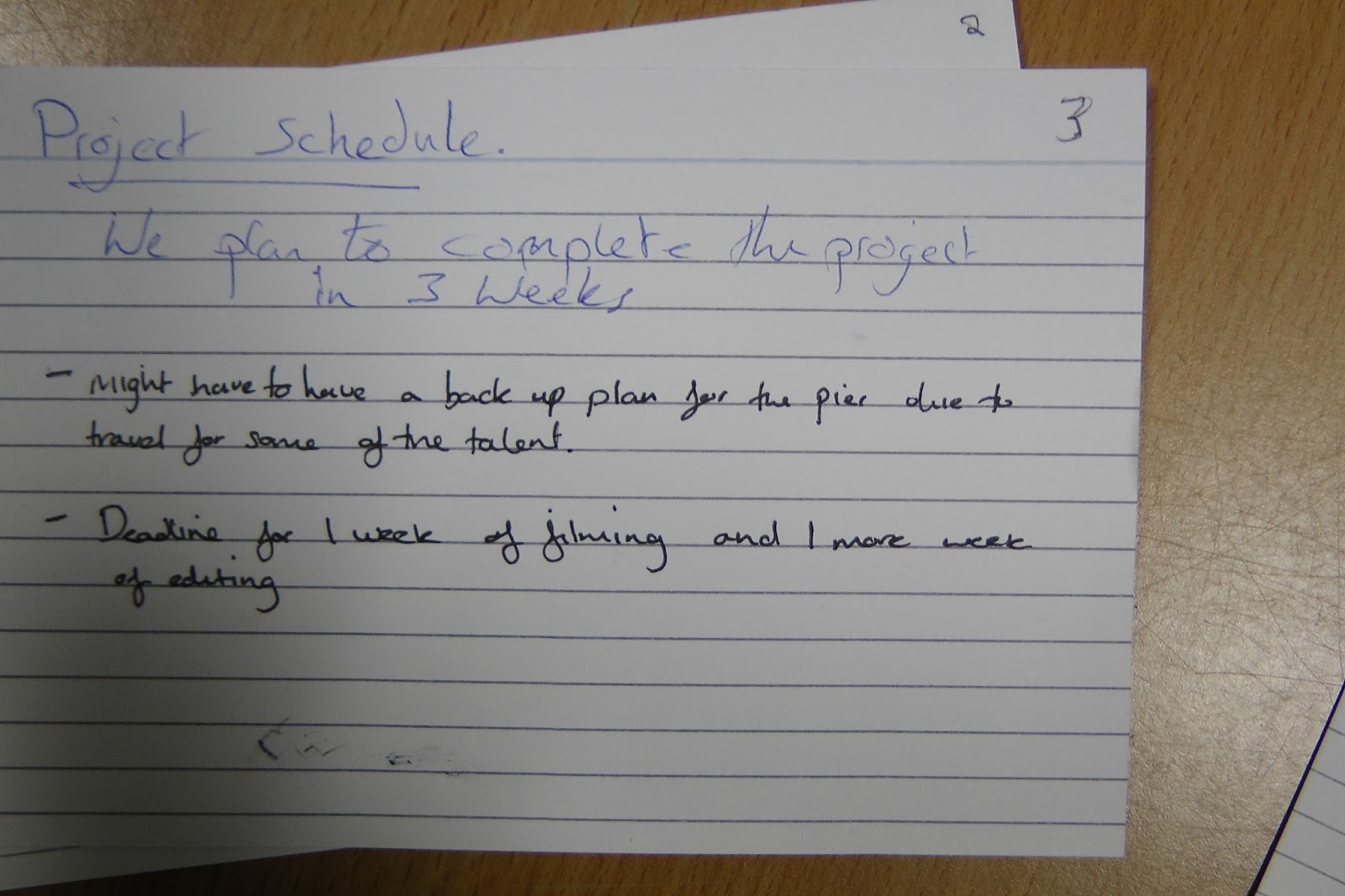
Time – When
working on a project in a group there will always be timing problems as you
have to rely on other members as well as yourself. Some timing problems could
be if that a member is late or away then that will put the production back. In
addition we have been given preliminary deadlines for the different parts of
the production. Again if the work is not up to standard or someone is away then
this will put the production back. In addition we was thinking of filming one
scene in dusk/night, in order to do this we would need to use out of college
hours and figure out what times would be the best to film this scene and if the
location is available.
Costs - We do not
need to purchase much for our production in which we are lucky for this. The only
thing in which may need to be purchased would be a police uniform as there is
not one in which we could use, however practically everything else we need is
available for us to use. In addition if we travel to other locations then
petrol money may be an issue.
Personnel – For our
production we are all going to have different acting roles, as well as doing
the camera work. However we may need some outside help. This would be great for
our production and have thought if we help out another group then they can help
us. The only down side would be helping the other group will put our production
behind time wise.
Resources – As
mentioned earlier, we mainly have all the resources we need and they are
already being provided for us, there are only a few things in which we may
need, so we will either need to purchase them for find them from somewhere
else.
Legal and
Ethical considerations – Our production would not be invading people’s
privacy as we will blur out car number plates if necessary, also we will not get
anyone else in the shot if they do not want to be. We will not give out our
talents information to anyone after they have signed the talent release form.
We will not be creating anything which will harm or offend people of religion
of different races.
Codes of
Practice – Our production will be up to all the standards that Ofcom
requires to be able to broadcast a production. We will also require our
broadcast to be played after the watershed as there will be some violence and
the younger audiences really should not be seeing this. There will be no vulgar
language in our production however the storyline is dark and seedy.
Copyright – Although
this production was influenced by other existing TV drama’s, this production is
not copying those drama’s in any way and all the ideas in this production are
non-copyrighted material. However if we require some music we may need to gain
rights to the music used.
Audience
Research – The primary audience for our production would be around
the ages of 20-40. Both genders would be interested because the hint of
violence may interest males however drama is a predominantly female genre. Also
our primary audience should be the social class of C1 or D. The secondary
audience for our production would be 40+, again both genders would be
interested and the social class of E or C2.
Audience
Figures – According to BARB, Silent Witness is number 9 and 10
in the top 30 most watched on BBC One both with around 7.3 million views. From
this we know that this show is very successful and as our production is like
this programme, there is a wide audience already to view our production.
Primary
Content Research – For the production there was questionnaires handed
out to the primary audience we wanted and good feedback was received and 90%
would want to watch this programme if it was aired. In addition to this I
pitched this idea to the class before my idea was chosen to be used and I got
positive responses from this pitch.
Secondary
Content Research – For the production we researched on BARB some
similar programmes which relate to our production and see how well they
performed. Sherlock, which I took inspiration from performed very well. It got
around 11 million views in January 2012. In addition Silent Witness also
performs very well with around 7 million views in January 2013.
Research
Into Competitors – There are many competitors in the Crime-drama genre,
such as Sherlock, Silent Witness and Elementary. All these shows perform very
well and the target audience of our production is the same as these three
shows. This shows that our target audience should be interested in our
production also. In addition our production should perform well.
Research
Into Market – There will be many Crime-drama’s around and always
will be but to push our production we need to use the USP which is the twist in
the story that it is the protagonist actually the murderer, this then should
attract the audience to our production. However, this USP may be easy to spot
which will then lose the production audience members.
Subscribe to:
Posts (Atom)